
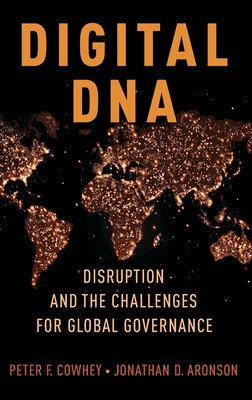
Digital DNA : Disruption and the Challenges for Global Governance
Book Details
Format
Hardback
ISBN-10
0190657936
ISBN-13
9780190657932
Publisher
Oxford University Press Inc
Imprint
Oxford University Press Inc
Country of Manufacture
US
Country of Publication
GB
Publication Date
Sep 7th, 2017
Print length
320 Pages
Weight
544 grams
Dimensions
16.30 x 23.90 x 2.50 cms
Product Classification:
Business innovationInternational business
KSh 9,250.00
Currently unavailable
0 in stock
Delivery Location
Delivery fee: Select location
Secure
Quality
Fast
Innovation in information and production technologies is generating both benefits and disruption, rapidly altering how firms and markets perform at a basic level. Digital DNA is an engaging examination of the opportunities, challenges, and ways that countries and the international community can govern developments for broad benefit.
Innovation in information and production technologies is creating benefits and disruption, profoundly altering how firms and markets perform. Digital DNA provides an in depth examination of the opportunities and challenges in the fast-changing global economy and lays out strategies that countries and the international community should embrace to promote robust growth while addressing the risks of this digital upheaval. Wisely guiding the transformation in innovation is a major challenge for global prosperity that affects everyonePeter Cowhey and Jonathan Aronson demonstrate how the digital revolution is transforming the business models of high tech industries but also of traditional agricultural, manufacturing, and service sector firms. The rapidity of change combines with the uncertainty of winners and losers to create political and economic tensions over how to adapt public policies to new technological and market surprises. The logic of the policy trade-offs confronting society, and the political economy of practical decision-making is explored through three developments: The rise of Cloud Computing and trans-border data flows; international collaboration to reduce cybersecurity risks; and the consequences of different national standards of digital privacy protection.The most appropriate global strategies will recognize that a significant diversity in individual national policies is inevitable. However, because digital technologies operate across national boundaries there is also a need for a common international baseline of policy fundamentals to facilitate "quasi-convergence" of these national policies. Cowhey and Aronson''s examination of these dynamic developments lead to a measured proposal for authoritative "soft rules" that requires governments to create policies that achieve certain objectives, but leaves the specific design to national discretion. These rules should embrace mechanisms to work with expert multi-stakeholder organizations to facilitate the implementation of formal agreements, enhance their political legitimacy and technical expertise, and build flexible learning into the governance regime. The result will be greater convergence of national policies and the space for the new innovation system to flourish.
Get Digital DNA by Jonathan D. Aronson, Peter F. Cowhey at the best price and quality guaranteed only at Werezi Africa's largest book ecommerce store. The book was published by Oxford University Press Inc and it has 320 pages.
Customers Who Bought This Also Bought

Lean Startup
KSh 3,050.00

Think Again
KSh 2,000.00

Fourth Industrial Revolution
KSh 2,700.00

Turning the Flywheel
KSh 1,800.00

Beyond Entrepreneurship 2.0
KSh 4,700.00

Confident AI
KSh 3,050.00

The Lean Startup
KSh 5,750.00

B2B Customer Experience
KSh 6,100.00

Slow Productivity
KSh 3,050.00

The Emergent Approach to Strategy
KSh 6,250.00

Principles of Fintech
KSh 8,100.00

Reverse Thinking
KSh 2,800.00
