
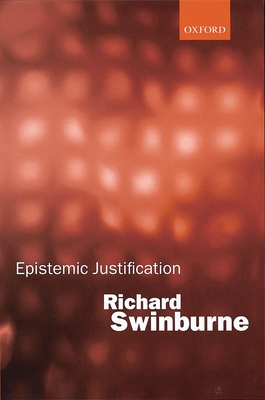
Epistemic Justification
Book Details
Format
Paperback / softback
ISBN-10
0199243794
ISBN-13
9780199243792
Publisher
Oxford University Press
Imprint
Oxford University Press
Country of Manufacture
GB
Country of Publication
GB
Publication Date
Jun 21st, 2001
Print length
270 Pages
Weight
380 grams
Dimensions
23.10 x 15.70 x 1.70 cms
KSh 10,100.00
Currently unavailable
0 in stock
Delivery Location
Delivery fee: Select location
Secure
Quality
Fast
Richard Swinburne offers an original treatment of a question at the heart of epistemology: what makes a belief a rational one, or one which the believer is justified in holding? He maps the many different accounts of epistemic justification, and distinguishes the different kinds of justification that they identify.
Richard Swinburne offers an original treatment of a question at the heart of epistemology: what makes a belief a rational one, or one which the believer is justified in holding? He maps the various totally different and purportedly rival accounts that philosophers give of epistemic justification (''internalist'' and ''externalist''), and argues that they are really accounts of different concepts. He distinguishes (as most epistemologists do not) between synchronic justification (justification at a time) and diachronic justification (synchronic justification resulting from adequate investigation) -- both internalist and externalist. He argus that most kinds of justification are worth having because (for different reasons) indicative of truth. However, it is only justification of intermalist kinds that can guide a believer''s actions. Swinburne goes on to show the usefulness of the probability calculus in elucidating how empirical evidence makes beliefs probably true: every proposition has an intrinsic probability (an a priori probability independent of empirical evidence) which may be increased or decreased by empirical evidence. This innovative and challenging book will refresh epistemology and rewrite its agenda.
Get Epistemic Justification by Richard Swinburne at the best price and quality guaranteed only at Werezi Africa's largest book ecommerce store. The book was published by Oxford University Press and it has 270 pages.
Customers Who Bought This Also Bought

A Treatise of Human Nature
KSh 2,700.00
Critique of Pure Reason
KSh 3,400.00

Sensuous Knowledge
KSh 4,500.00

Critique of Pure Reason, Abridged
KSh 3,600.00
Sharing Thoughts
KSh 17,000.00

The Critique of Pure Reason
KSh 6,450.00

Critique of Pure Reason
KSh 7,250.00
An Inquiry Into Meaning and Truth
KSh 3,750.00
Intelligence and Spirit
KSh 5,750.00
The Social Construction of What?
KSh 5,200.00

Discourse on Method and Related Writings
KSh 2,000.00

Beyond Good and Evil
KSh 2,000.00
More by Richard Swinburne
Faith and Reason
KSh 9,850.00

Personal Identity
KSh 7,200.00
The Existence of God
KSh 8,500.00
The Coherence of Theism
KSh 6,850.00
The Christian God
KSh 10,000.00

Was Jesus God?
KSh 3,950.00
The Evolution of the Soul
KSh 11,500.00
Revelation
KSh 9,500.00

The Evolution of the Soul
KSh 37,150.00

Was Jesus God?
KSh 1,800.00

The Resurrection of God Incarnate
KSh 9,600.00
Is There a God?
KSh 2,450.00
