
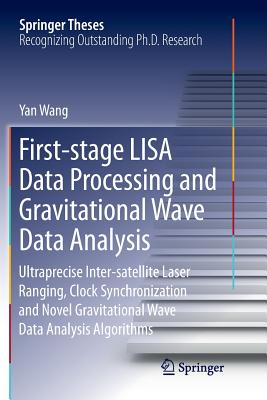
First-stage LISA Data Processing and Gravitational Wave Data Analysis : Ultraprecise Inter-satellite Laser Ranging, Clock Synchronization and Novel Gravitational Wave Data Analysis Algorithms
Softcover reprint of the original 1st ed. 2016
by
Yan Wang
Book Details
Format
Paperback / softback
Book Series
Springer Theses
ISBN-10
3319799479
ISBN-13
9783319799476
Edition
Softcover reprint of the original 1st ed. 2016
Publisher
Springer International Publishing AG
Imprint
Springer International Publishing AG
Country of Manufacture
GB
Country of Publication
GB
Publication Date
Mar 29th, 2019
Print length
228 Pages
Product Classification:
Scientific standardsScientific standards, measurement etcScientific standards, measurement etcMensuration & systems of measurementGravityOptical physicsLaser physicsQuantum physics (quantum mechanics & quantum field theory)Quantum physics (quantum mechanics and quantum field theory)AstrophysicsData miningExpert systems / knowledge-based systems
KSh 16,200.00
Currently unavailable
0 in stock
Delivery Location
Delivery fee: Select location
Secure
Quality
Fast
This thesis covers a diverse set of topics related to space-based gravitational wave detectors such as the Laser Interferometer Space Antenna (LISA). The core of the thesis is devoted to the preprocessing of the interferometric link data for a LISA constellation, specifically developing optimal Kalman filters to reduce arm length noise due to clock noise. The approach is to apply Kalman filters of increasing complexity to make optimal estimates of relevant quantities such as constellation arm length, relative clock drift, and Doppler frequencies based on the available measurement data. Depending on the complexity of the filter and the simulated data, these Kalman filter estimates can provide up to a few orders of magnitude improvement over simpler estimators. While the basic concept of the LISA measurement (Time Delay Interferometry) was worked out some time ago, this work brings a level of rigor to the processing of the constellation-level data products. The thesis concludes with some topics related to the eLISA such as a new class of phenomenological waveforms for extreme mass-ratio inspiral sources (EMRIs, one of the main source for eLISA), an octahedral space-based GW detector that does not require drag-free test masses, and some efficient template-search algorithms for the case of relatively high SNR signals.
Get First-stage LISA Data Processing and Gravitational Wave Data Analysis by Yan Wang at the best price and quality guaranteed only at Werezi Africa's largest book ecommerce store. The book was published by Springer International Publishing AG and it has 228 pages.
Customers Who Bought This Also Bought

Disappearing Spoon...and other true tales from the Periodic Table
KSh 2,150.00

The Three Pillars of Confidence in Chemical Measurement
KSh 8,100.00

Electroanalytical Methods
KSh 18,000.00

Models and Measures in Measurements and Monitoring
KSh 27,000.00

Magnetic Monopole Noise
KSh 16,200.00

Measurement of Nonlinear Ultrasonic Characteristics
KSh 28,800.00

Nuclear Power Plants
KSh 23,400.00

Industrial Measurements in Machining
KSh 16,200.00

Modern Requirements for Noise Immunity Aircraft Navigation Equipment
KSh 21,600.00

Sensors, Algorithms and Applications for Structural Health Monitoring
KSh 18,000.00

Ion Tracks in Apatite and Quartz
KSh 16,200.00

Error Compensation for Industrial Robots
KSh 14,400.00
More by Yan Wang

Mobile Technologies for Smart Healthcare System Design
KSh 27,000.00

A Comparative Study on the Translation of Detective Stories from a Systemic Functional Perspective
KSh 16,200.00

Quantitative Analysis and Optimal Control of Energy Efficiency in Discrete Manufacturing System
KSh 23,400.00

???? - Jincheng shu xiang (1640)
KSh 8,850.00

Quantitative Analysis and Optimal Control of Energy Efficiency in Discrete Manufacturing System
KSh 23,400.00

A Comparative Study on the Translation of Detective Stories from a Systemic Functional Perspective
KSh 16,200.00

Chinese Labour Law
KSh 16,200.00

Filter Design for System Modeling, State Estimation and Fault Diagnosis
KSh 9,350.00

Impulsive Synchronization of Complex Dynamical Networks
KSh 21,600.00

Lattice Boltzmann And Gas Kinetic Flux Solvers: Theory And Applications
KSh 22,500.00

The Spine: Medical & Surgical Management
KSh 79,000.00

Gu Wu for Secondary Mandarin Chinese
KSh 7,900.00
More in This Genre
Disappearing Spoon...and other true tales from the Periodic Table
KSh 2,150.00
The Three Pillars of Confidence in Chemical Measurement
KSh 8,100.00
Electroanalytical Methods
KSh 18,000.00
Models and Measures in Measurements and Monitoring
KSh 27,000.00
Magnetic Monopole Noise
KSh 16,200.00
Measurement of Nonlinear Ultrasonic Characteristics
KSh 28,800.00
