
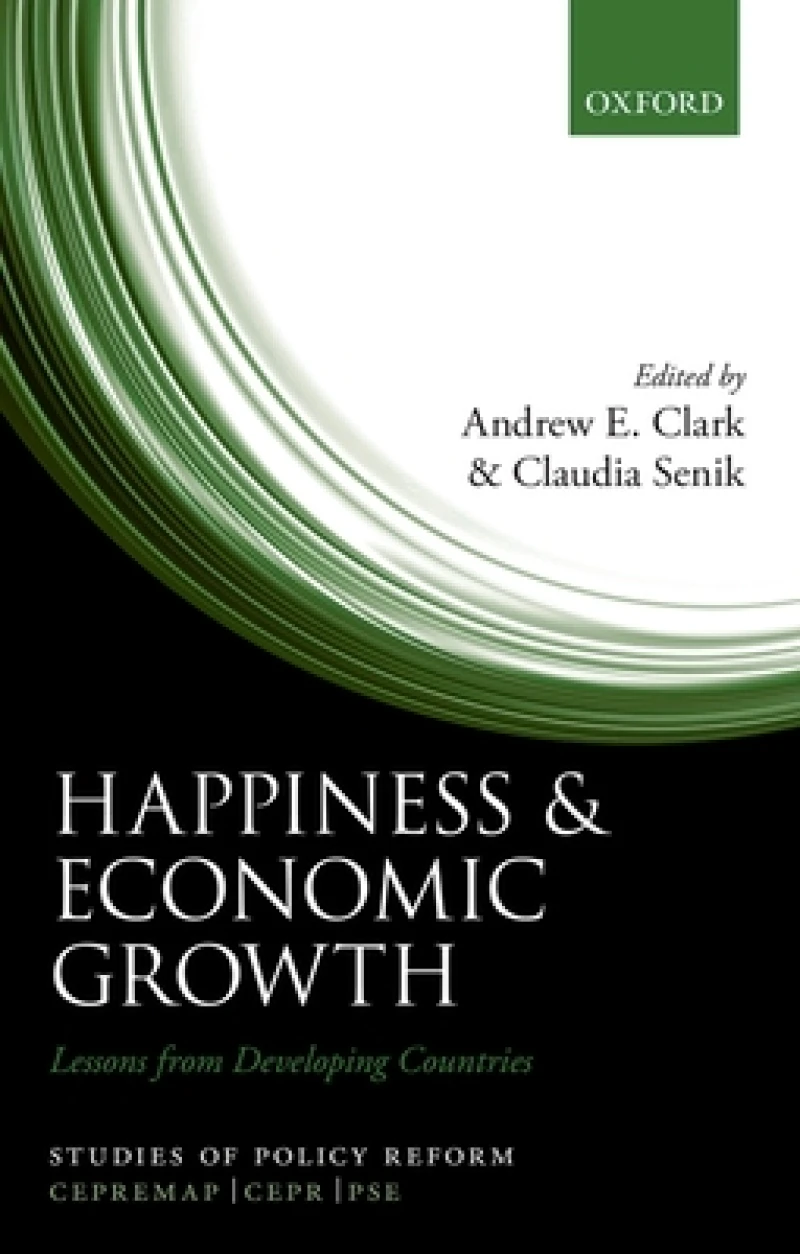
Happiness and Economic Growth : Lessons from Developing Countries
Book Details
Format
Hardback or Cased Book
Book Series
Studies of Policy Reform
ISBN-10
0198723652
ISBN-13
9780198723653
Publisher
Oxford University Press
Imprint
Oxford University Press
Country of Manufacture
GB
Country of Publication
GB
Publication Date
Nov 20th, 2014
Print length
292 Pages
Weight
496 grams
Dimensions
22.20 x 14.50 x 2.20 cms
Product Classification:
Economic growthBehavioural economicsDevelopment economics & emerging economiesWelfare economics
Ksh 15,450.00
Manufactured on Demand
0 in stock
Delivery Location
Delivery fee: Select location
Secure
Quality
Fast
Analyses the relationship between income and subjective well-being, and in particular in the context of developing countries. Several chapters focus on China and underline how the rise in unemployment and income inequality has undermined the well-being effects of economic development.
This volume, arising from a PSE-CEPREMAP-DIMeco conference, includes contributions by the some of the best-known researchers in happiness economics and development economics, including Richard Easterlin, who gave his name to the ''Easterlin paradox'' that GDP growth does not improve happiness over the long run. Many chapters underline the difficulty of increasing well-being in developing countries, including China, even in the presence of sustained income growth. This is notably due to the importance of income comparisons to others, adaptation (so that we get used to higher income), and the growing inequality of income. In particular, rank in the local income distribution is shown to be important, creating a beggar-thy-neighbour effect in happiness. Wealth comparisons in China are exacerbated by the gender imbalance, as the competition for brides creates a striking phenomenon of conspicuous consumption on the housing market. Policy has to be aware of these effects. This applies in particular to those who try to use self-reported subjective well-being in order to generate a ''social subjective poverty line'', which is a key issue in developing countries. However, the news is not only bad from the point of view of developing countries. One piece of good news is that GDP growth often seems to go hand-in-hand with lower happiness inequality, and thereby reduces the risk of extreme unhappiness.
Get Happiness and Economic Growth by at the best price and quality guaranteed only at Werezi Africa's largest book ecommerce store. The book was published by Oxford University Press and it has pages.

