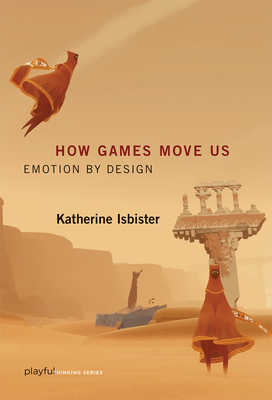
How Games Move Us : Emotion by Design
Book Details
Format
Paperback / softback
Book Series
Playful Thinking
ISBN-10
0262534452
ISBN-13
9780262534451
Publisher
MIT Press Ltd
Imprint
MIT Press
Country of Manufacture
US
Country of Publication
GB
Publication Date
Oct 27th, 2017
Print length
192 Pages
Weight
194 grams
Dimensions
20.30 x 13.80 x 1.30 cms
Product Classification:
NoneEducational: First / native language: Readers and reading schemes
KSh 3,600.00
Werezi Extended Catalogue
Delivery in 12 days
1 copies in stock
Delivery Location
Delivery fee: Select location
Delivery in 12 days
Secure
Quality
Fast
An engaging examination of how video game design creates strong and positive emotional experiences for players—with examples from Journey, Train, Little Big Planet, and more.
This is a renaissance moment for video games—in the variety of genres they represent, and the range of emotional territory they cover. But how do games create emotion? In How Games Move Us, Katherine Isbister takes the reader on a timely and novel exploration of the design techniques that evoke strong emotions for players. She counters arguments that games are creating a generation of isolated, emotionally numb, antisocial loners. Games can actually play a powerful role in creating empathy and other strong, positive emotional experiences; they reveal these qualities over time, through the act of playing. She offers a nuanced, systematic examination of exactly how games can influence emotion and social connection, with examples—drawn from popular, indie, and art games—that unpack the gamer’s experience.
Isbister describes choice and flow, two qualities that distinguish games from other media, and explains how game developers build upon these qualities using avatars, non-player characters, and character customization, in both solo and social play. She shows how designers use physical movement to enhance players’ emotional experience, and examines long-distance networked play. She illustrates the use of these design methods with examples that range from Sony’s Little Big Planet to the much-praised indie game Journey to art games like Brenda Romero’s Train.
Isbister’s analysis shows us a new way to think about games, helping us appreciate them as an innovative and powerful medium for doing what film, literature, and other creative media do: helping us to understand ourselves and what it means to be human.
This is a renaissance moment for video games—in the variety of genres they represent, and the range of emotional territory they cover. But how do games create emotion? In How Games Move Us, Katherine Isbister takes the reader on a timely and novel exploration of the design techniques that evoke strong emotions for players. She counters arguments that games are creating a generation of isolated, emotionally numb, antisocial loners. Games can actually play a powerful role in creating empathy and other strong, positive emotional experiences; they reveal these qualities over time, through the act of playing. She offers a nuanced, systematic examination of exactly how games can influence emotion and social connection, with examples—drawn from popular, indie, and art games—that unpack the gamer’s experience.
Isbister describes choice and flow, two qualities that distinguish games from other media, and explains how game developers build upon these qualities using avatars, non-player characters, and character customization, in both solo and social play. She shows how designers use physical movement to enhance players’ emotional experience, and examines long-distance networked play. She illustrates the use of these design methods with examples that range from Sony’s Little Big Planet to the much-praised indie game Journey to art games like Brenda Romero’s Train.
Isbister’s analysis shows us a new way to think about games, helping us appreciate them as an innovative and powerful medium for doing what film, literature, and other creative media do: helping us to understand ourselves and what it means to be human.
Get How Games Move Us by Katherine Isbister at the best price and quality guaranteed only at Werezi Africa's largest book ecommerce store. The book was published by MIT Press Ltd and it has 192 pages.
Customers Who Bought This Also Bought

Foundation Game Design with Flash
KSh 6,250.00

Meet the Kinect
KSh 4,250.00

Introduction to 3D Game Programming with DirectX 12
KSh 10,650.00

Successful Digital Painting
KSh 26,300.00

Pattern Language for Game Design
KSh 11,000.00
![Classic Game Design [OP]](https://book-images.us-southeast-1.linodeobjects.com/images/9781937585976.jpg)
Classic Game Design [OP]
KSh 7,850.00

The Pocket Mentor for Game Artists
KSh 6,500.00

The Raspberry Pi Guide to Retro Gaming
KSh 3,600.00

Pattern Language for Game Design
KSh 30,950.00

Hacking the Kinect
KSh 5,650.00

Games User Research
KSh 9,650.00

Practical Game Design
KSh 11,250.00