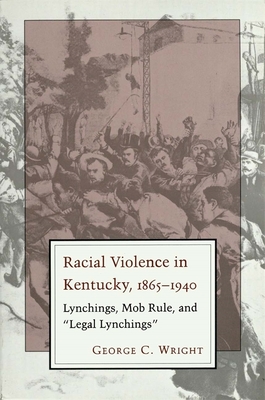

Life Behind a Veil : Blacks in Louisville, Kentucky, 1865-1930
Book Details
Format
Paperback / softback
ISBN-10
0807130567
ISBN-13
9780807130568
Publisher
Louisiana State University Press
Imprint
Louisiana State University Press
Country of Manufacture
US
Country of Publication
GB
Publication Date
Sep 1st, 2004
Print length
320 Pages
Weight
472 grams
Dimensions
22.80 x 15.20 x 1.80 cms
KSh 5,700.00
Currently unavailable
0 in stock
Delivery Location
Delivery fee: Select location
Secure
Quality
Fast
An account of race relations, black response to white discrimination, and the black community behind the walls of segregation in a border town. The title echoes Blyden Jackson's recollection of his childhood in Louisville, where blacks were always aware that there were two very distinct Louisvilles, one of which they were excluded from.
In the period between the Civil War and the Great Depression, Louisville, Kentucky was host to what George C. Wright calls ""a polite form of racism."" There were no lynchings or race riots, and to a great extent, Louisville blacks escaped the harsh violence that was a fact of life for blacks in the Deep South. Furthermore, black Louisvillians consistently enjoyed and exercised an oft-contested but never effectively retracted enfranchisement. However, their votes usually did not amount to any real political leverage, and there were no radical improvements in civil rights during this period. Instead, there existed a delicate balance between relative privilege and enforced passivity. A substantial paternalism carried over from antebellum days in Louisville, and many leading white citizens lent support to a limited uplifting of blacks in society. They helped blacks establish their own schools, hospitals, and other institutions. But the dual purpose that such actions served, providing assistance while making the maintenance of strict segregation easier, was not incidental. Whites salved their consequences without really threatening an established order. And blacks, obliged to be grateful for the assistance, generally refrained from arguing for real social and political equality for fear of jeopardizing a partially improved situation and regressing to a status similar to that of other southern blacks. In Life Behind a Veil: Blacks in Louisville, Kentucky, 1865 - 1930, George Wright looks at the particulars of this form of racism. He also looks at the ways in which blacks made the most of their less than ideal position, focusing on the institutions that were central to their lives. Blacks in Louisville boasted the first library for blacks in the United States, as well as black-owned banks, hospitals, churches, settlement houses, and social clubs. These supported and reinforced a sense of community, self-esteem, and pride that was often undermined by the white world.Life Behind a Veil is a comprehensive account of race relations, black response to white discrimination, and the black community behind the walls of segregation in this border town. The title echoes Blyden Jackson's recollection of his childhood in Louisville, where blacks were always aware that there were two very distinct Louisvilles, one of which they were excluded from.
Get Life Behind a Veil by George C. Wright at the best price and quality guaranteed only at Werezi Africa's largest book ecommerce store. The book was published by Louisiana State University Press and it has 320 pages.
Customers Who Bought This Also Bought
Crusade for Justice – The Autobiography of Ida B. Wells, Second Edition
KSh 4,050.00

Killers of the Flower Moon
KSh 2,000.00
Warmth of Other Suns
KSh 3,050.00

Frederick Douglass
KSh 3,350.00

107 Days
KSh 4,500.00

Second Treatise of Government – Norton Library
KSh 1,600.00

Tuesdays With Morrie
KSh 2,000.00
My Bondage and My Freedom
KSh 1,600.00

Hidden Figures
KSh 2,000.00

America, América
KSh 3,650.00

Holding the Line
KSh 2,000.00

Nuclear Folly
KSh 3,050.00