
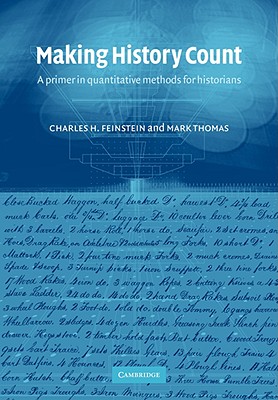
Making History Count : A Primer in Quantitative Methods for Historians
Book Details
Format
Paperback / softback
ISBN-10
0521001374
ISBN-13
9780521001373
Publisher
Cambridge University Press
Imprint
Cambridge University Press
Country of Manufacture
GB
Country of Publication
GB
Publication Date
Aug 29th, 2002
Print length
572 Pages
Weight
1,004 grams
Dimensions
17.20 x 24.40 x 2.60 cms
KSh 9,600.00
Currently unavailable
0 in stock
Delivery Location
Delivery fee: Select location
Secure
Quality
Fast
This authoritative guide to quantitative methods is designed to be used as the basic text for taught graduate courses, and upper-level students working on their own. Illustrated with tables, graphs and diagrams, it introduces key topics, and supported by five specific historical data-sets, available electronically in downloadable and manipulatable form.
Making History Count introduces the main quantitative methods used in historical research. The emphasis is on intuitive understanding and application of the concepts, rather than formal statistics; no knowledge of mathematics beyond simple arithmetic is required. The techniques are illustrated by applications in social, political, demographic and economic history. Students will learn to read and evaluate the application of the quantitative methods used in many books and articles, and to assess the historical conclusions drawn from them. They will also see how quantitative techniques can open up new aspects of an enquiry, and supplement and strengthen other methods of research. This textbook will encourage students to recognize the benefits of using quantitative methods in their own research projects. The text is clearly illustrated with tables, graphs and diagrams, leading the student through key topics. Additional support includes five specific historical data-sets, available from the Cambridge website.
Get Making History Count by Charles H. Feinstein, Mark Thomas at the best price and quality guaranteed only at Werezi Africa's largest book ecommerce store. The book was published by Cambridge University Press and it has 572 pages.
Customers Who Bought This Also Bought

Finding Your Ethical Research Self
KSh 6,650.00

Island Time
KSh 18,900.00

Fundamental Issues, Measurement and Study Design
KSh 35,100.00

Building a Digital Chemistry Lab
KSh 8,100.00

Data Analysis
KSh 35,100.00

Research Design in Political Science
KSh 6,300.00

Crime Scripting
KSh 7,900.00

Renegade
KSh 30,950.00

Research Design in Political Science
KSh 21,600.00
The Community-Based PhD
KSh 5,050.00
Practical Research Methods for Media and Cultural Studies
KSh 6,900.00

Crime Scripting
KSh 30,950.00
More by Charles H. Feinstein, Mark Thomas

Evidence
KSh 8,050.00
An Economic History of South Africa
KSh 7,050.00

As Used On the Famous Nelson Mandela
KSh 2,900.00

A/As Level Computer Science for Wjec/Eduqas
KSh 7,850.00

Liar''s Quartet: Bravo Figaro!, Cuckooed, The Red Shed - Playscripts, Notes and Commentary
KSh 1,800.00

100 Acts Of Minor Dissent
KSh 2,150.00

A/As Level Computer Science for Wjec/Eduqas + Cambridge Elevate, 2-year Access
KSh 8,800.00

Belching Out the Devil
KSh 2,900.00

Revise SQE Criminal Law 2025/26
KSh 3,050.00

Revise SQE Oral Skills for SQE2: Questions & Answers in Advocacy
KSh 3,250.00

Revise SQE Criminal Practice 2025/26
KSh 3,050.00

Extreme Rambling
KSh 3,050.00
