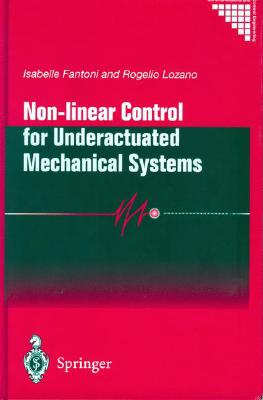
Non-linear Control for Underactuated Mechanical Systems
Edition. ed.
Book Details
Format
Hardback
Book Series
Communications and Control Engineering
ISBN-10
1852334231
ISBN-13
9781852334239
Edition
Edition. ed.
Publisher
Springer London Ltd
Imprint
Springer London Ltd
Country of Manufacture
GB
Country of Publication
GB
Publication Date
Oct 15th, 2001
Print length
306 Pages
Weight
580 grams
Dimensions
16.10 x 24.50 x 2.30 cms
KSh 12,950.00
Currently unavailable
0 in stock
Delivery Location
Delivery fee: Select location
Secure
Quality
Fast
Deals with the application of modern control theory to some important underactuated mechanical systems, from the inverted pendulum to the helicopter model. This book helps readers gain experience in the modelling of mechanical systems and familiarize with control methods for non-linear systems.
1 Introduction.- 1.1 Motivation.- 1.2 Outline of the book.- 1.2.1 Energy-based control approaches for several underactuated mechanical systems.- 1.2.2 The hovercraft model, the PVTOL aircraft and the helicopter.- 2 Theoretical preliminaries.- 2.1 Lyapunov stability.- 2.2 Lyapunov direct method.- 2.3 Passivity and dissipativity.- 2.4 Stabilization.- 2.5 Non-holonomic systems.- 2.6 Underactuated systems.- 2.7 Homoclinic orbit.- 3 The cart-pole system.- 3.1 Introduction.- 3.2 Model derivation.- 3.2.1 System model using Newton''s second law.- 3.2.2 Euler-Lagrange''s equations.- 3.3 Passivity of the inverted pendulum.- 3.4 Controllability of the linearized model.- 3.5 Stabilizing control law.- 3.5.1 The homoclinic orbit.- 3.5.2 Stabilization around the homoclinic orbit.- 3.5.3 Domain of attraction.- 3.3 Stability analysis.- 3.4 Simulation results.- 3.5 Experimental results.- 3.6 Conclusions.- 4 A convey-crane system.- 4.1 Introduction.- 4.2 Model.- 4.3 Passivity of the system.- 4.4 Damping oscillations control law.- 4.5 Asymptotic stability analysis.- 4.6 Simulation results.- 4.7 Concluding remarks.- 5 The pendubot system.- 5.1 Introduction.- 5.2 System dynamics.- 5.2.1 Equations of motion via Euler-Lagrange formulation.- 5.3 Passivity of the pendubot.- 5.4 Linearization of the system.- 5.5 Control law for the top position.- 5.5.1 The homoclinic orbit.- 5.5.2 Stabilization around the homoclinic orbit.- 5.6 Stability analysis.- 5.7 Simulation results.- 5.8 Experimental results.- 5.9 Conclusions.- 6 The Furuta pendulum.- 6.1 Introduction.- 6.2 Modeling of the system.- 6.2.1 Energy of the system.- 6.2.2 Euler-Lagrange dynamic equations.- 6.3.3 Passivity properties of the Furuta pendulum.- 6.3 Controllability of the linearized model.- 6.4 Stabilization algorithm.- 6.5 Stability analysis.- 6.6 Simulation results.- 6.7 Conclusions.- 7 The reaction wheel pendulum.- 7.1 Introduction.- 7.2 The reaction wheel pendulum.- 7.2.1 Equations of motion.- 7.2.2 Passivity properties of the system.- 7.2.3 Linearization of the system.- 7.2.4 Feedback linearization.- 7.3 First energy-based control design.- 7.4 Second energy-based controller.- 7.5 Simulation results.- 7.6 Conclusions.- 7.7 Generalization for Euler-Lagrange systems.- 8 The planar flexible-joint robot.- 8.1 Introduction.- 8.2 The two-link planar robot.- 8.2.1 Equations of motion.- 8.2.2 Linearization of the system.- 8.2.3 Passivity of the system.- 8.3 Control law for the two-link manipulator.- 8.3.1 Equivalent closed-loop interconnection.- 8.4 Stability analysis.- 8.5 Simulation results.- 8.6 The three-link planar robot.- 8.7 Control law for the three-link robot.- 8.8 Stability analysis.- 8.9 Simulation results.- 8.10 Conclusions.- 9 The PPR planar manipulator.- 9.1 Introduction.- 9.2 System dynamics.- 9.2.1 Equations of motion via Euler-Lagrange formulation.- 9.2.2 Passivity properties of the planar PPR manipulator.- 9.3 Energy-based stabilizing control law.- 9.3.1 Equivalent closed-loop interconnection.- 9.4 Convergence and stability analysis.- 9.5 Simulation results.- 9.6 Conclusions.- 10 The ball and beam acting on the ball.- 10.1 Introduction.- 10.2 Dynamical model.- 10.2.1 Mechanical properties.- 10.3 The control law.- 10.3.1 Stability analysis.- 10.4 Simulation results.- 10.5 Conclusions.- 11 The hovercraft model.- 11.1 Introduction.- 11.2 The hovercraft model.- 11.2.1 System model using Newton''s second law.- 11.2.2 Euler-Lagrange''s equations.- 11.2.3 Controllability of the linearized system.- 11.3 Stabilizing control law for the velocity.- 11.4 Stabilization of the position>.- 11.4.1 First approach.- 11.4.2 Second approach.- 11.4.3 Third approach.- 11.5 Simulation results.- 11.6 Conclusions.- 12 The PVTOL aircraft.- 12.1 Introduction.- 12.2 The PVTOL aircraft model.- 12.3 Input-output linearization of the system.- 12.4 Second stabilization approach.- 12.5 Third stabilization algorithm.- 12.6 Forwarding control law.- 12.6.1 First step: a Lyapunov function for the altitudeangle (y, ...
Get Non-linear Control for Underactuated Mechanical Systems by Isabelle Fantoni, Rogelio Lozano at the best price and quality guaranteed only at Werezi Africa's largest book ecommerce store. The book was published by Springer London Ltd and it has 306 pages.
Customers Who Bought This Also Bought
Dynamics, Ergodic Theory and Geometry
KSh 9,550.00
Differential Equations
KSh 13,500.00
Synergetic Cities
KSh 27,000.00
Green''s Functions and Ordered Exponentials
KSh 24,650.00

High-Order Harmonics Generation in Plasmas
KSh 27,000.00

Nonlinear Dynamics and Renormalization Group
KSh 12,600.00
International Conference on Theory and Application in Nonlinear Dynamics (ICAND 2012)
KSh 23,400.00

Introduction to Modern Dynamics
KSh 7,750.00
Spectral and Dynamical Stability of Nonlinear Waves
KSh 14,200.00

Geometric Bifurcation Theory
KSh 28,800.00
Advances in Discrete Differential Geometry
KSh 7,900.00
Traces and Emergence of Nonlinear Programming
KSh 16,200.00