
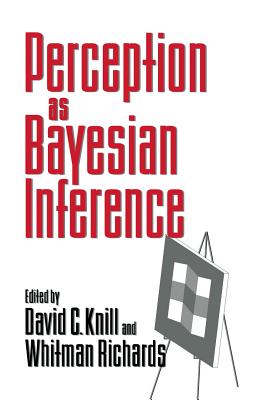
Perception as Bayesian Inference
Book Details
Format
Hardback
ISBN-10
052146109X
ISBN-13
9780521461092
Publisher
Cambridge University Press
Imprint
Cambridge University Press
Country of Manufacture
GB
Country of Publication
GB
Publication Date
Sep 13th, 1996
Print length
530 Pages
Weight
1,163 grams
Dimensions
25.40 x 17.80 x 2.90 cms
KSh 26,450.00
Currently unavailable
0 in stock
Delivery Location
Delivery fee: Select location
Secure
Quality
Fast
This 1996 book describes an exciting paradigm for building and testing theories of human visual perception based on Bayesian probability theory. Leading researchers in computer vision and experimental vision science describe theoretical frameworks, applications to specific problems, and implications for experimental studies.
Bayesian probability theory has emerged not only as a powerful tool for building computational theories of vision, but also as a general paradigm for studying human visual perception. This 1996 book provides an introduction to and critical analysis of the Bayesian paradigm. Leading researchers in computer vision and experimental vision science describe general theoretical frameworks for modelling vision, detailed applications to specific problems and implications for experimental studies of human perception. The book provides a dialogue between different perspectives both within chapters, which draw on insights from experimental and computational work, and between chapters, through commentaries written by the contributors on each others' work. Students and researchers in cognitive and visual science will find much to interest them in this thought-provoking collection.
Get Perception as Bayesian Inference by David C. Knill at the best price and quality guaranteed only at Werezi Africa's largest book ecommerce store. The book was published by Cambridge University Press and it has 530 pages.
Customers Who Bought This Also Bought

The Emotional Brain
KSh 2,350.00
Art of Loving
KSh 1,800.00

A Toolkit for Your Emotions
KSh 2,700.00
Anthropologist on Mars
KSh 2,000.00
Musicophilia
KSh 2,000.00

Man Who Mistook His Wife for a Hat
KSh 2,000.00

Multiple Pathways of Cognitive Aging
KSh 16,550.00

Counselling and Language Impairment
KSh 30,950.00

Counselling and Language Impairment
KSh 5,400.00

Talking Time
KSh 27,900.00
Neuropsychology of Asians and Asian-Americans
KSh 16,200.00
Head Masters
KSh 6,250.00
