
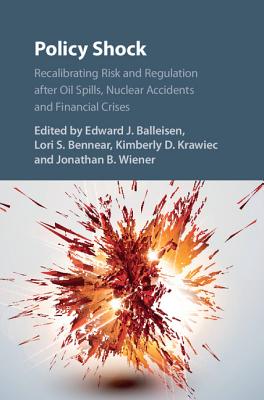
Policy Shock : Recalibrating Risk and Regulation after Oil Spills, Nuclear Accidents and Financial Crises
Book Details
Format
Hardback
ISBN-10
1107140218
ISBN-13
9781107140219
Publisher
Cambridge University Press
Imprint
Cambridge University Press
Country of Manufacture
GB
Country of Publication
GB
Publication Date
Nov 2nd, 2017
Print length
590 Pages
Weight
960 grams
Dimensions
16.10 x 23.40 x 4.00 cms
KSh 24,300.00
Currently unavailable
0 in stock
Delivery Location
Delivery fee: Select location
Secure
Quality
Fast
Through compelling case studies about oil spills, nuclear accidents and financial crises, Policy Shock shows how past crises have reshaped regulation, and how policy-makers can learn from crises in the future. Drawing on insights from across the social sciences, it will interest scholars, regulators and other participants in regulatory policy.
Policy Shock examines how policy-makers in industrialized democracies respond to major crises. After the immediate challenges of disaster management, crises often reveal new evidence or frame new normative perspectives that drive reforms designed to prevent future events of a similar magnitude. Such responses vary widely - from cosmetically masking inaction, to creating stronger incentive systems, requiring greater transparency, reorganizing government institutions and tightening regulatory standards. This book situates post-crisis regulatory policy-making through a set of conceptual essays written by leading scholars from economics, psychology and political science, which probe the latest thinking about risk analysis, risk perceptions, focusing events and narrative politics. It then presents ten historically-rich case studies that engage with crisis events in three policy domains: offshore oil, nuclear power and finance. It considers how governments can prepare to learn from crisis events - by creating standing expert investigative agencies to identify crisis causes and frame policy recommendations.
Get Policy Shock by Edward J. Balleisen at the best price and quality guaranteed only at Werezi Africa's largest book ecommerce store. The book was published by Cambridge University Press and it has 590 pages.
Customers Who Bought This Also Bought

We Wish to Inform You That Tomorrow We Will Be Killed With Our Families
KSh 2,150.00

Shock Doctrine
KSh 3,050.00
Plague Year
KSh 2,000.00

Famine in Cambodia
KSh 26,700.00
Living Conditions, Disasters and Development
KSh 5,050.00

Second Language Learning and the COVID-19 Pandemic
KSh 21,250.00

Famine in Cambodia
KSh 6,650.00
What Is a City?
KSh 5,500.00
Minority Citizens in Disasters
KSh 5,500.00
Silent Violence – Food, Famine, and Peasantry in Northern Nigeria
KSh 9,350.00

The Weather Report
KSh 3,250.00
Bush Wives and Girl Soldiers
KSh 16,550.00
