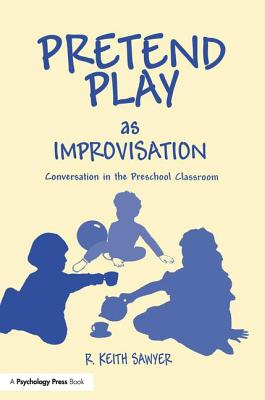
Pretend Play As Improvisation : Conversation in the Preschool Classroom
Book Details
Format
Hardback
ISBN-10
0805821198
ISBN-13
9780805821192
Publisher
Taylor & Francis Inc
Imprint
Psychology Press
Country of Manufacture
US
Country of Publication
GB
Publication Date
Jan 1st, 1997
Print length
232 Pages
Weight
424 grams
Dimensions
23.10 x 16.10 x 1.90 cms
KSh 30,950.00
Currently unavailable
0 in stock
Delivery Location
Delivery fee: Select location
Secure
Quality
Fast
Examines preschoolers' pretend play in the context of a theory of improvisational performance genres. The text argues that the social skills gained from improvisation are linked to the child's developing ability to improvise with other creative performers.
Everyday conversations including gossip, boasting, flirting, teasing, and informative discussions are highly creative, improvised interactions. Children''s play is also an important, often improvisational activity. One of the most improvisational games among 3- to 5-year-old children is social pretend play--also called fantasy play, sociodramatic play, or role play. Children''s imaginations have free reign during pretend play. Conversations in these play episodes are far more improvisational than the average adult conversation. Because pretend play occurs in a dramatized, fantasy world, it is less constrained by social and physical reality.
This book adds to our understanding of preschoolers'' pretend play by examining it in the context of a theory of improvisational performance genres. This theory, derived from in-depth analyses of the implicit and explicit rules of theatrical improvisation, proves to generalize to pretend play as well. The two genres share several characteristics:
* There is no script; they are created in the moment.
* There are loose outlines of structure which guide the performance.
* They are collective; no one person decides what will happen.
Because group improvisational genres are collective and unscripted, improvisational creativity is a collective social process.
The pretend play literature states that this improvisational behavior is most prevalent during the same years that many other social and cognitive skills are developing. Children between the ages of 3 and 5 begin to develop representations of their own and others'' mental states as well as learn to represent and construct narratives. Freudian psychologists and other personality theorists have identified these years as critical in the development of the personality. The author believes that if we can demonstrate that children''s improvisational abilities develop during these years--and that their fantasy improvisations become more complex and creative--it might suggest that these social skills are linked to the child''s developing ability to improvise with other creative performers.
This book adds to our understanding of preschoolers'' pretend play by examining it in the context of a theory of improvisational performance genres. This theory, derived from in-depth analyses of the implicit and explicit rules of theatrical improvisation, proves to generalize to pretend play as well. The two genres share several characteristics:
* There is no script; they are created in the moment.
* There are loose outlines of structure which guide the performance.
* They are collective; no one person decides what will happen.
Because group improvisational genres are collective and unscripted, improvisational creativity is a collective social process.
The pretend play literature states that this improvisational behavior is most prevalent during the same years that many other social and cognitive skills are developing. Children between the ages of 3 and 5 begin to develop representations of their own and others'' mental states as well as learn to represent and construct narratives. Freudian psychologists and other personality theorists have identified these years as critical in the development of the personality. The author believes that if we can demonstrate that children''s improvisational abilities develop during these years--and that their fantasy improvisations become more complex and creative--it might suggest that these social skills are linked to the child''s developing ability to improvise with other creative performers.
Get Pretend Play As Improvisation by R. Keith Sawyer at the best price and quality guaranteed only at Werezi Africa's largest book ecommerce store. The book was published by Taylor & Francis Inc and it has 232 pages.
Customers Who Bought This Also Bought

The Elements of Choice
KSh 2,350.00
The Behavior of Social Justice
KSh 11,250.00

Culture, Biology, and Sexuality
KSh 4,650.00

Behavior Theory in Public Health Practice and Research
KSh 12,600.00
Minority Citizens in Disasters
KSh 5,500.00

Observations on Transaction
KSh 8,750.00

The Cambridge Handbook of Violent Behavior and Aggression
KSh 13,000.00

APA Handbook of Behavior Analysis
KSh 60,650.00

Policing the Crowd
KSh 30,950.00

Psychological Ownership and Consumer Behavior
KSh 25,200.00

Retail Marketing
KSh 7,050.00

Transportation, Traffic Safety and Health - Human Behavior
KSh 12,950.00