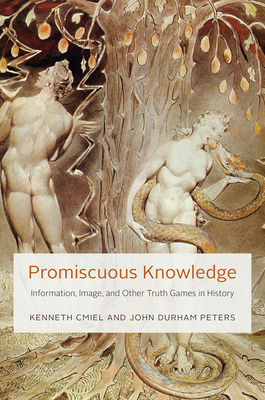
Promiscuous Knowledge : Information, Image, and Other Truth Games in History
Book Details
Format
Hardback
ISBN-10
022661185X
ISBN-13
9780226611853
Publisher
The University of Chicago Press
Imprint
University of Chicago Press
Country of Manufacture
US
Country of Publication
GB
Publication Date
Dec 20th, 2019
Print length
336 Pages
Product Classification:
History: theory & methods
KSh 5,600.00
Currently unavailable
0 in stock
Delivery Location
Delivery fee: Select location
Secure
Quality
Fast
Sergey Brin, a cofounder of Google, once compared the perfect search engine to the "mind of God." As the modern face of promiscuous knowledge, however, Google's divine omniscience traffics indifferently in news, maps, weather, and porn. This book, begun by the late Kenneth Cmiel and completed by his close friend John Durham Peters, provides a genealogy of the information age from its early origins up to the reign of Google. It examines how we think about fact, image, and knowledge, centering on the different ways that claims of truth are complicated when they pass to a larger public. To explore these ideas, Cmiel and Peters focus on three main time periods--the late nineteenth century, 1925 to 1945, and 1975 to 2000, with constant reference to the present. Cmiel's original text examines the collapse he saw in the growing gulf between politics and aesthetics in postmodern architecture, the distancing of images from everyday life in magical realist cinema, the waning support for national betterment through taxation, and the inability of a single presentational strategy to contain the social whole. Peters brings Cmiel's study into the present moment, providing the backstory to current controversies over filter-bubbles, echo chambers, and "fake news." A hybrid work from two innovative thinkers, Promiscuous Knowledge is an enlightening contribution to our understanding of the internet and the profuse visual culture of our time.
Get Promiscuous Knowledge by John Durham Peters, Kenneth Cmiel at the best price and quality guaranteed only at Werezi Africa's largest book ecommerce store. The book was published by The University of Chicago Press and it has 336 pages.
Customers Who Bought This Also Bought

How Civil Wars Start
KSh 2,000.00
The Muqaddimah – An Introduction to History – Abridged Edition
KSh 3,650.00

The Uses and Abuses of History
KSh 1,600.00

Introduction to the Philosophy of History
KSh 2,900.00

D-Day: The Unheard Tapes
KSh 2,000.00
Xrepublic
KSh 850.00
Xrepublic
KSh 1,450.00

On History
KSh 2,500.00

Reframing Indigenous Biography
KSh 26,300.00
Subaltern Geographies
KSh 7,400.00

Closer to the Truth Than Any Fact – Memoir, Memory, and Jim Crow
KSh 9,250.00
Imagining the Past
KSh 6,250.00