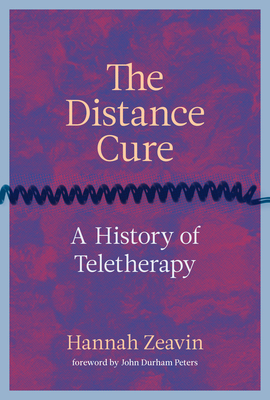
The Distance Cure : A History of Teletherapy
Book Details
Format
Hardback
ISBN-10
0262045923
ISBN-13
9780262045926
Publisher
MIT Press Ltd
Imprint
MIT Press
Country of Manufacture
GB
Country of Publication
GB
Publication Date
Aug 17th, 2021
Print length
296 Pages
Weight
612 grams
Dimensions
16.30 x 23.70 x 2.90 cms
Product Classification:
Psychology
KSh 5,950.00
Werezi Extended Catalogue
Delivery in 4 days
1 copies in stock
Delivery Location
Delivery fee: Select location
Delivery in 4 days
Secure
Quality
Fast
Psychotherapy across distance and time, from Freuds treatments by mail to crisis hotlines, radio call-ins, chatbots, and Zoom sessions.
Therapy has long understood itself as taking place in a room, with two (or more) people engaged in person-to-person conversation. And yet, starting with Freuds treatments by mail, psychotherapy has operated through multiple communication technologies and media. These have included advice columns, radio broadcasts, crisis hotlines, video, personal computers, and mobile phones; the therapists (broadly defined) can be professional or untrained, strangers or chatbots. In The Distance Cure, Hannah Zeavin proposes a reconfiguration of the traditional therapeutic dyad of therapist and patient as a triad: therapist, patient, and communication technology.
Zeavin tracks the history of teletherapy (understood as a therapeutic interaction over distance) and its metamorphosis from a model of cure to one of contingent help. She describes its initial use in ongoing care, its role in crisis intervention and symptom management, and our pandemic-mandated reliance on regular Zoom sessions. Her account of the distanced intimacy of the therapeutic relationship offers a powerful rejoinder to the notion that contact across distance (or screens) is always less useful, or useless, to the person seeking therapeutic treatment or connection. At the same time, these modes of care can quickly become a backdoor for surveillance and disrupt ethical standards important to the therapeutic relationship. The history of the conventional therapeutic scenario cannot be told in isolation from its shadow form, teletherapy. Therapy, Zeavin tells us, was never just a talking cure; it has always been a communication cure.
Therapy has long understood itself as taking place in a room, with two (or more) people engaged in person-to-person conversation. And yet, starting with Freuds treatments by mail, psychotherapy has operated through multiple communication technologies and media. These have included advice columns, radio broadcasts, crisis hotlines, video, personal computers, and mobile phones; the therapists (broadly defined) can be professional or untrained, strangers or chatbots. In The Distance Cure, Hannah Zeavin proposes a reconfiguration of the traditional therapeutic dyad of therapist and patient as a triad: therapist, patient, and communication technology.
Zeavin tracks the history of teletherapy (understood as a therapeutic interaction over distance) and its metamorphosis from a model of cure to one of contingent help. She describes its initial use in ongoing care, its role in crisis intervention and symptom management, and our pandemic-mandated reliance on regular Zoom sessions. Her account of the distanced intimacy of the therapeutic relationship offers a powerful rejoinder to the notion that contact across distance (or screens) is always less useful, or useless, to the person seeking therapeutic treatment or connection. At the same time, these modes of care can quickly become a backdoor for surveillance and disrupt ethical standards important to the therapeutic relationship. The history of the conventional therapeutic scenario cannot be told in isolation from its shadow form, teletherapy. Therapy, Zeavin tells us, was never just a talking cure; it has always been a communication cure.
Get The Distance Cure by Hannah Zeavin, John Durham Peters at the best price and quality guaranteed only at Werezi Africa's largest book ecommerce store. The book was published by MIT Press Ltd and it has 296 pages.
Customers Who Bought This Also Bought

This Too Shall Pass
KSh 2,000.00

Maybe You Should Talk to Someone
KSh 2,000.00

David and Goliath
KSh 2,350.00

Corruptible
KSh 2,350.00

Damaged but Not Destroyed
KSh 4,850.00

Antifragile
KSh 2,700.00

Late Bloomers
KSh 2,700.00

Mind Fixers – Psychiatry`s Troubled Search for the Biology of Mental Illness
KSh 2,900.00

The Life Of The Mind
KSh 3,950.00

Why You Act the Way You Do
KSh 1,600.00

Lost Girls
KSh 2,000.00

Dark Psychology and Manipulation
KSh 3,550.00