
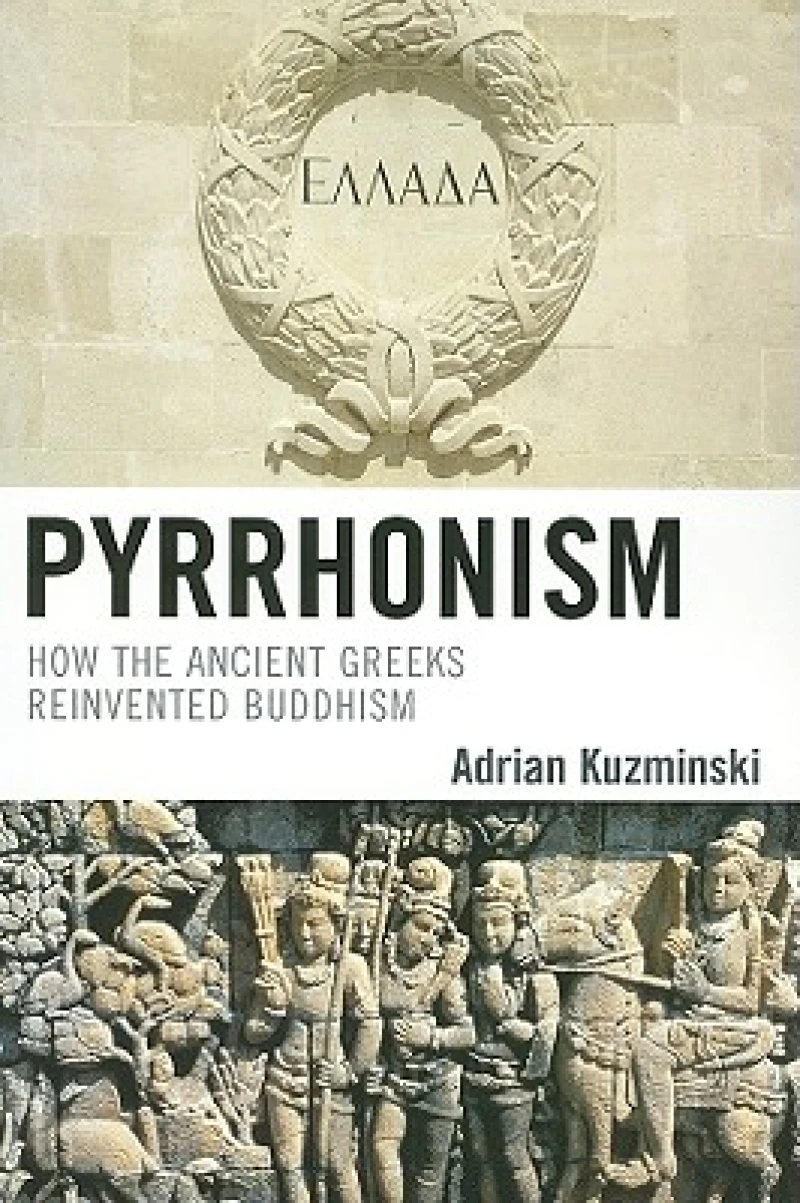
Pyrrhonism : How the Ancient Greeks Reinvented Buddhism
Book Details
Format
Paperback / Softback
Book Series
Studies in Comparative Philosophy and Religion
ISBN-10
0739125079
ISBN-13
9780739125076
Publisher
Bloomsbury Publishing Plc
Imprint
Lexington Books
Country of Manufacture
GB
Country of Publication
GB
Publication Date
May 10th, 2010
Print length
170 Pages
Weight
272 grams
Dimensions
17.90 x 22.90 x 1.30 cms
Product Classification:
Western philosophy: Ancient, to c 500Buddhism
Ksh 8,600.00
Manufactured on Demand
Delivery in 29 days
Delivery Location
Delivery fee: Select location
Delivery in 29 days
Secure
Quality
Fast
Pyrrhonism is commonly confused with scepticism in Western philosophy. Unlike sceptics, who believe there are no true beliefs, Pyrrhonists suspend judgment about all beliefs, including the belief that there are no true beliefs. Pyrrhonism was developed by a line of ancient Greek philosophers, from its founder Pyrrho of Elis in the fourth century BCE through Sextus Empiricus in the second century CE. Pyrrhonists offer no view, theory, or knowledge about the world, but recommend instead a practice, a distinct way of life, designed to suspend beliefs and ease suffering. Adrian Kuzminski examines Pyrrhonism in terms of its striking similarity to some Eastern non-dogmatic soteriological traditions-particularly Madhyamaka Buddhism. He argues that its origin can plausibly be traced to the contacts between Pyrrho and the sages he encountered in India, where he traveled with Alexander the Great. Although Pyrrhonism has not been practiced in the West since ancient times, its insights have occasionally been independently recovered, most recently in the work of Ludwig Wittgenstein. Kuzminski shows that Pyrrhonism remains relevant perhaps more than ever as an antidote to today's cultures of belief.
Pyrrhonism is commonly confused with scepticism in Western philosophy. Unlike sceptics, who believe there are no true beliefs, Pyrrhonists suspend judgment about all beliefs, including the belief that there are no true beliefs. Pyrrhonism was developed by a line of ancient Greek philosophers, from its founder Pyrrho of Elis in the fourth century BCE through Sextus Empiricus in the second century CE. Pyrrhonists offer no view, theory, or knowledge about the world, but recommend instead a practice, a distinct way of life, designed to suspend beliefs and ease suffering. Adrian Kuzminski examines Pyrrhonism in terms of its striking similarity to some Eastern non-dogmatic soteriological traditions-particularly Madhyamaka Buddhism. He argues that its origin can plausibly be traced to the contacts between Pyrrho and the sages he encountered in India, where he traveled with Alexander the Great. Although Pyrrhonism has not been practiced in the West since ancient times, its insights have occasionally been independently recovered, most recently in the work of Ludwig Wittgenstein. Kuzminski shows that Pyrrhonism remains relevant perhaps more than ever as an antidote to today''s cultures of belief.
Get Pyrrhonism by at the best price and quality guaranteed only at Werezi Africa's largest book ecommerce store. The book was published by Bloomsbury Publishing Plc and it has pages.

