
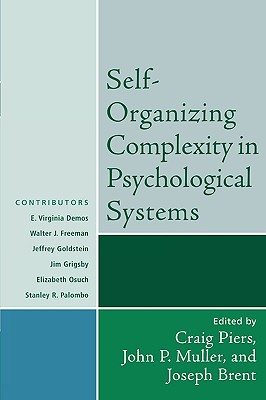
Self-Organizing Complexity in Psychological Systems
Book Details
Format
Paperback / softback
Book Series
Psychological Issues
ISBN-10
0765705265
ISBN-13
9780765705266
Publisher
Jason Aronson Publishers
Imprint
Jason Aronson Publishers
Country of Manufacture
US
Country of Publication
GB
Publication Date
Apr 18th, 2007
Print length
192 Pages
Weight
304 grams
Dimensions
15.20 x 22.80 x 1.50 cms
KSh 9,900.00
Currently unavailable
0 in stock
Delivery Location
Delivery fee: Select location
Secure
Quality
Fast
This volume addresses itself to the ways in which the so-called ''new sciences of complexity'' can deepen and broaden neurobiological and psychological theories of mind. Complexity theory has gained increasing attention over the past 20 years across diverse areas of inquiry, including mathematics, physics, economics, biology, and the social sciences. Complexity theory concerns itself with how nonlinear dynamical systems evolve and change over time and draws on research arising from chaos theory, self-organization, artificial intelligence and cellular automata, to name a few. This emerging discipline shows many points of convergence with psychological theory and practice, emphasizing that history is irreversible and discontinuous, that small early interventions can have large and unexpected later effects, that each life trajectory is unique yet patterned, that measurement error is not random and cannot be justifiably distributed equally across experimental conditions, that a system''s collective and coordinated organization is emergent and often arises from simple components in interaction, and that change is more likely to emerge under conditions of optimal turbulence.
Get Self-Organizing Complexity in Psychological Systems by Craig Piers at the best price and quality guaranteed only at Werezi Africa's largest book ecommerce store. The book was published by Jason Aronson Publishers and it has 192 pages.
Customers Who Bought This Also Bought

The Emotional Brain
KSh 2,350.00
Art of Loving
KSh 1,800.00

A Toolkit for Your Emotions
KSh 2,700.00
Anthropologist on Mars
KSh 2,000.00
Musicophilia
KSh 2,000.00

Man Who Mistook His Wife for a Hat
KSh 2,000.00

Multiple Pathways of Cognitive Aging
KSh 16,550.00

Counselling and Language Impairment
KSh 30,950.00

Counselling and Language Impairment
KSh 5,400.00

Talking Time
KSh 27,900.00
Neuropsychology of Asians and Asian-Americans
KSh 16,200.00
Head Masters
KSh 6,250.00
