
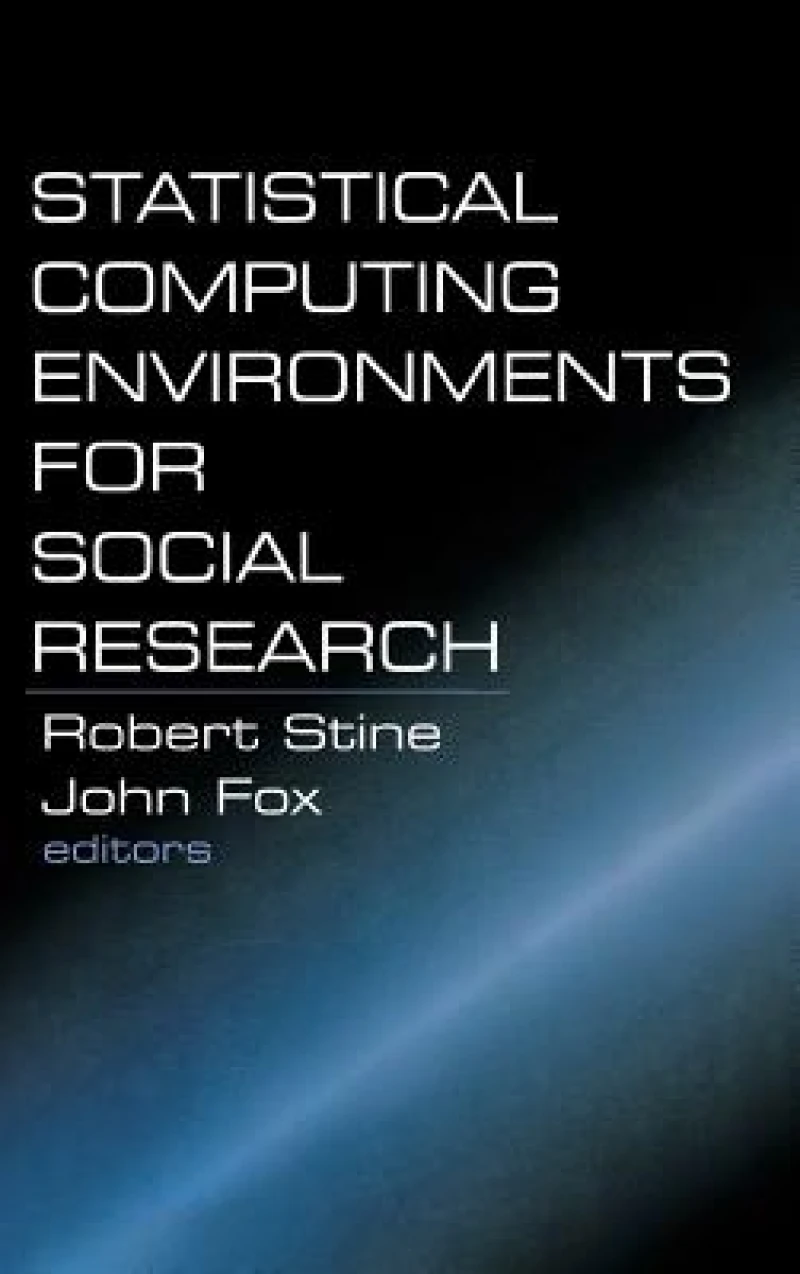
Statistical Computing Environments for Social Research
Book Details
Format
Hardback or Cased Book
ISBN-10
0761902694
ISBN-13
9780761902690
Publisher
SAGE Publications Inc
Imprint
SAGE Publications Inc
Country of Manufacture
GB
Country of Publication
GB
Publication Date
Oct 21st, 1996
Print length
256 Pages
Weight
540 grams
Product Classification:
Social research & statisticsSocial research and statisticsPsychologyComputer science
Ksh 26,450.00
Manufactured on Demand
0 in stock
Delivery Location
Delivery fee: Select location
Secure
Quality
Fast
The nature of statistics has changed from classical notions of hypothesis testing toward graphical and exploratory data analysis that exploits the flexibility of interactive computing and graphical displays. With contributions from some of the leading researchers in the social sciences and statistics, Statistical Computing Environments for Social Research describes seven statistical computing environments--APL2STAT, GAUSS, Lisp-Stat, Mathematica, S, SAS/IML, and Stata--that can be used effectively in graphical and exploratory modeling. These statistical computing environments, in contrast to a standard statistical package, provide programming tools for building other statistical applications. Programmability, flexible data structures, and--in the case of some of the computing environments--graphical interfaces and object-oriented programming permit researchers to take advantage of emerging statistical methodologies. Three additional chapters, describing the Axis, R-code, and ViSta statistical packages, demonstrate how researchers have extended one of the computing environments--Lisp-Stat--to produce significant statistical applications employing graphical interfaces to statistical software. To illustrate the capabilities of the seven statistical computing environments, each contributor uses the same data set to perform three computing tasks: robust regression, bootstrap resampling, and kernel-density estimation. The same data are analyzed in the chapters on Axis, R-code, and ViSta packages. The chapters in Statistical Computing Environments for Social Research illustrate important ideas and techniques in modern data analysis and statistical computing, ideas and techniques that readers will be able to apply in the more effective analysis of their own data.
Get Statistical Computing Environments for Social Research by at the best price and quality guaranteed only at Werezi Africa's largest book ecommerce store. The book was published by SAGE Publications Inc and it has pages.

