
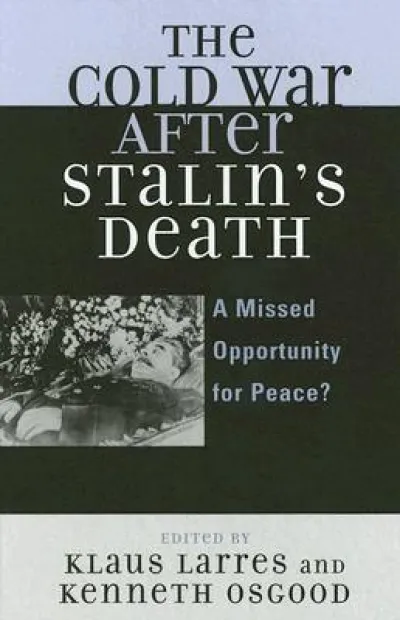
The Cold War after Stalin's Death : A Missed Opportunity for Peace?
Book Details
Format
Hardback or Cased Book
Book Series
The Harvard Cold War Studies Book Series
ISBN-10
0742554511
ISBN-13
9780742554511
Publisher
Bloomsbury Publishing Plc
Imprint
Rowman & Littlefield Publishers
Country of Manufacture
GB
Country of Publication
GB
Publication Date
Oct 12th, 2006
Print length
352 Pages
Weight
694 grams
Dimensions
23.70 x 15.50 x 2.80 cms
Product Classification:
General & world historyThe Cold War
Ksh 19,800.00
Manufactured on Demand
0 in stock
Delivery Location
Delivery fee: Select location
Secure
Quality
Fast
After Stalin's death in March 1953, the Cold War changed almost overnight. The Soviet Union embarked on a course of reconciliation and greater openness. However, despite an end to the Korean War and progress on many other outstanding East-West questions, the Western world remained mistrustful of Soviet motives and policies and Soviet leaders remained suspicious of Western intentions. Less than a decade after Stalin's death the Berlin Wall was erected and the Cuban Missile Crisis brought the world close to nuclear annihilation. Was this development unavoidable? Was an opportunity missed to overcome and terminate the Cold War? Was there a possibility for the creation of a more stable, less threatening, and less costly world in both human and material terms? It is only now, after the end of the Cold War and based on recently declassified western documents and revelations from once-closed archives in the former Soviet Union, Eastern Europe, and China, that new light can be shed on the nature of international Cold War policies in the years after Stalin's death. The essays in this book offer a historical understanding of this crucial period of the Cold War, assessing both the possibilities for change and the obstacles to detente. The book draws on the collective talents of an international group of scholars with a wide range of historical, geographical, and linguistic expertise. All of the essays are based on original research, many of them drawing from previously inaccessible archival documents from both the East and West. This book should be read by everyone interested in the final stage of the defining conflict that was the Cold War. Contributions by: Csaba Bekes, Gunter Bischof, Jeffrey Brooks, Ira Chernus, Jerald A. Combs, Lloyd Gardner, Jussi M. Hanhimaki, Hope M. Harrison, Tsuyoshi Hasegawa, Mark Kramer, Klaus Larres, Vojtech Mastny, Kenneth Osgood, Kathryn C. Statler, and Qiang Zhai
After Stalin''s death in March 1953, the Cold War changed almost overnight. The Soviet Union embarked on a course of reconciliation and greater openness. However, despite an end to the Korean War and progress on many other outstanding East-West questions, the Western world remained mistrustful of Soviet motives and policies and Soviet leaders remained suspicious of Western intentions. Less than a decade after Stalin''s death the Berlin Wall was erected and the Cuban Missile Crisis brought the world close to nuclear annihilation. Was this development unavoidable? Was an opportunity missed to overcome and terminate the Cold War? Was there a possibility for the creation of a more stable, less threatening, and less costly world in both human and material terms? It is only now, after the end of the Cold War and based on recently declassified western documents and revelations from once-closed archives in the former Soviet Union, Eastern Europe, and China, that new light can be shed on the nature of international Cold War policies in the years after Stalin''s death. The essays in this book offer a historical understanding of this crucial period of the Cold War, assessing both the possibilities for change and the obstacles to détente. The book draws on the collective talents of an international group of scholars with a wide range of historical, geographical, and linguistic expertise. All of the essays are based on original research, many of them drawing from previously inaccessible archival documents from both the East and West. This book should be read by everyone interested in the final stage of the defining conflict that was the Cold War.Contributions by: Csaba Békés, Günter Bischof, Jeffrey Brooks, Ira Chernus, Jerald A. Combs, Lloyd Gardner, Jussi M. Hanhimäki, Hope M. Harrison, Tsuyoshi Hasegawa, Mark Kramer, Klaus Larres, Vojtech Mastny, Kenneth Osgood, Kathryn C. Statler, and Qiang Zhai
Get The Cold War after Stalin's Death by at the best price and quality guaranteed only at Werezi Africa's largest book ecommerce store. The book was published by Bloomsbury Publishing Plc and it has pages.

