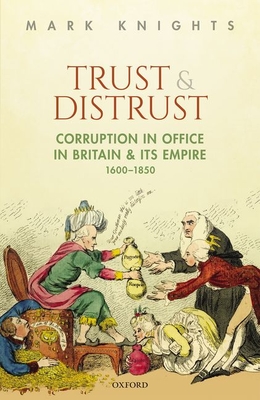
Trust and Distrust : Corruption in Office in Britain and its Empire, 1600-1850
by
Mark Knights
Book Details
Format
Hardback
ISBN-10
0198796242
ISBN-13
9780198796244
Publisher
Oxford University Press
Imprint
Oxford University Press
Country of Manufacture
GB
Country of Publication
GB
Publication Date
Dec 9th, 2021
Print length
506 Pages
Weight
912 grams
Dimensions
16.40 x 24.10 x 3.60 cms
Product Classification:
16th century, c 1500 to c 159917th century, c 1600 to c 169918th century, c 1700 to c 179919th century, c 1800 to c 1899British & Irish historyEarly modern history: c 1450/1500 to c 1700Modern history to 20th century: c 1700 to c 1900Social & cultural historyColonialism & imperialismHistoryEuropean historySocial and cultural historyColonialism and imperialism
KSh 8,650.00
Currently unavailable
0 in stock
Delivery Location
Delivery fee: Select location
Secure
Quality
Fast
Mark Knights offers the first overview of Britain's history of corruption in office in the pre-modern era, 1600-1850. Drawing on extensive archival material, Knights shows how corruption in the domestic and imperial spheres interacted, and how the concept of corruption developed during this period, changing British ideas of trust and distrust.
Trust and Distrust offers the first overview of Britain''s history of corruption in office in the pre-modern era, 1600-1850, and as such will appeal not only to historians, but also to political and social scientists. Mark Knights paints a picture of the interaction of the domestic and imperial stories of corruption in office, showing how these stories were intertwined and related. Linking corruption in office to the domestic and imperial state has not been attempted before, and Knights does this by drawing on extensive interdisciplinary sources relating to the East India Company as well as other colonial officials in the Atlantic World and elsewhere in Britain''s emerging empire.Both ''corruption'' and ''office'' were concepts that were in evolution during the period 1600-1850 and underwent very significant but protracted change which this study charts and seeks to explain. The book makes innovative use of the concept of trust, which helped to shape office in ways that underlined principles of selflessness, disinterestedness, integrity, and accountability in officials.
Get Trust and Distrust by Mark Knights at the best price and quality guaranteed only at Werezi Africa's largest book ecommerce store. The book was published by Oxford University Press and it has 506 pages.
Customers Who Bought This Also Bought

Churchill
KSh 3,700.00

Difficult Women
KSh 2,350.00

Legacy of Violence
KSh 3,150.00
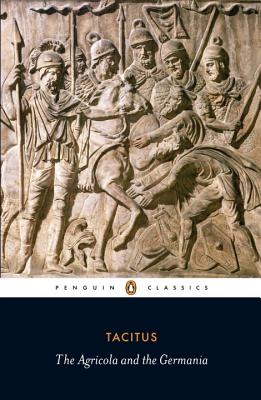
Agricola and the Germania
KSh 2,350.00
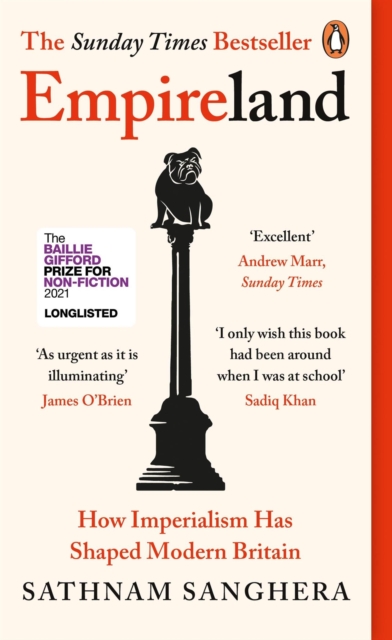
Empireland
KSh 2,150.00

The History of the Kings of Britain
KSh 2,350.00

Siege
KSh 2,000.00

Anarchy
KSh 2,700.00
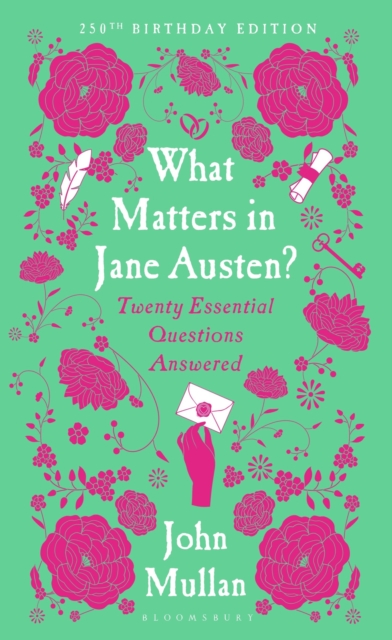
What Matters in Jane Austen?
KSh 2,700.00
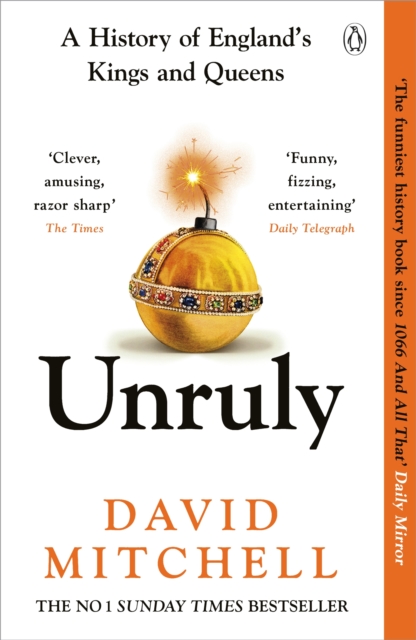
Unruly
KSh 2,150.00
Map Of A Nation
KSh 2,350.00

Black and British
KSh 2,350.00