
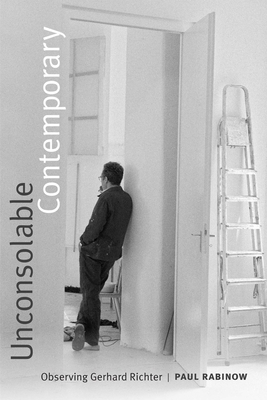
Unconsolable Contemporary : Observing Gerhard Richter
by
Paul Rabinow
Book Details
Format
Paperback / softback
ISBN-10
0822370018
ISBN-13
9780822370017
Publisher
Duke University Press
Imprint
Duke University Press
Country of Manufacture
US
Country of Publication
GB
Publication Date
Nov 24th, 2017
Print length
176 Pages
Weight
274 grams
Dimensions
15.50 x 22.70 x 1.20 cms
KSh 4,150.00
Currently unavailable
0 in stock
Delivery Location
Delivery fee: Select location
Secure
Quality
Fast
Paul Rabinow continues his explorations of "a philosophic anthropology of the contemporary" by examining the work of German painter Gerhard Richter. Defining the contemporary as a moving ratio in which the modern becomes historical, Rabinow uses Richter's work to illustrate how meaning is created within the contemporary.
In Unconsolable Contemporary Paul Rabinow continues his explorations of "a philosophic anthropology of the contemporary." Defining the contemporary as a moving ratio in which the modern becomes historical, Rabinow shows how an anthropological ethos of the contemporary can be realized by drawing on the work of art historians, cultural critics, social theorists, and others, thereby inventing a methodology he calls anthropological assemblage. He focuses on the work and persona of German painter Gerhard Richter, demonstrating how reflecting on Richter''s work provides rich insights into the practices and stylization of what, following Aby Warburg, one might call "the afterlife of the modern." Rabinow opens with analyses of Richter''s recent Birkenau exhibit: both the artwork and its critical framing. He then chronicles Richter''s experiments in image-making as well as his subtle inclusion of art historical and critical discourses about the modern. This, Rabinow contends, enables Richter to signal his awareness of the stakes of such theorizing while refusing the positioning of his work by modernist critical theorists. In this innovative work, Rabinow elucidates the ways meaning is created within the contemporary.
Get Unconsolable Contemporary by Paul Rabinow at the best price and quality guaranteed only at Werezi Africa's largest book ecommerce store. The book was published by Duke University Press and it has 176 pages.
Customers Who Bought This Also Bought

Bring No Clothes
KSh 2,350.00

Art and knowledge after 1900
KSh 6,000.00

Art and knowledge after 1900
KSh 15,300.00

What Is It That Will Last?
KSh 8,500.00
Slow Art – The Experience of Looking, Sacred Images to James Turrell
KSh 4,750.00

Diary of Frida Kahlo
KSh 4,550.00

So Much Longing in So Little Space
KSh 3,050.00

The Man Who Stole the Gods
KSh 3,600.00

Artists and Their Cats
KSh 2,350.00
Contemporary Painting
KSh 3,600.00
Expressionism
KSh 3,400.00
Central and Eastern European Art Since 1950
KSh 3,050.00
More by Paul Rabinow

Anthropos Today
KSh 6,300.00
Michel Foucault
KSh 11,500.00
Marking Time
KSh 5,750.00

Designing Human Practices – An Experiment with Synthetic Biology
KSh 5,150.00

Reflections on Fieldwork in Morocco
KSh 4,500.00
Demands of the Day
KSh 4,150.00

French DNA
KSh 5,100.00

French Modern – Norms and Forms of the Social Environment
KSh 7,200.00
Essays on the Anthropology of Reason
KSh 7,550.00
The Accompaniment
KSh 4,750.00
Michel Foucault
KSh 32,750.00
The Accompaniment
KSh 14,400.00
