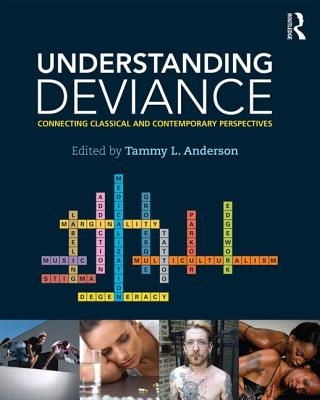
Understanding Deviance : Connecting Classical and Contemporary Perspectives
Book Details
Delivery Location
Delivery fee: Select location
In this collection of 48 reprinted and completely original articles, Tammy Anderson gives her fellow instructors of undergraduate deviance a refreshing way to energize and revitalize their courses. [36 are reprints; 12 are original to this text/anthology]
First, in 12 separate sections, she presents a wide range of deviant behaviors, traits, and conditions including: underage drinking and drunk driving, doping in elite sports, gang behavior, community crime, juvenile delinquency, hate crime, prison violence and transgendered prisoners, mental illness, drug-using women and domestic violence, obesity, tattooing, sexual fetishes, prostitution, drug epidemics, viral pandemics, crime control strategies and racial inequality, gay neighborhoods, HIV and bugchasers, and (lastly) youth, multicultural identity and music scenes.
Second, her pairing of "classic" and "contemporary" viewpoints about deviance and social control not only "connects" important literatures of the past to today’s (student) readers, her "connections framework" also helps all of us see social life and social processes more clearly when alternative meanings are accorded to similar forms of deviant behavior. We also learn how to appreciate and interact with those who see things differently from ourselves. This may better equip us to reach common goals in an increasingly diverse and ever-changing world.
Third, a major teaching goal of Anderson’s anthology is to sharpen students’ critical thinking skills by forcing them to look at how a deviant behavior, trait or condition, can be viewed from opposing or alternative perspectives. By learning to see deviance from multiple perspectives, students will better understand their own and other’s behavior and experiences and be able to anticipate future trends. Balancing multiple perspectives may also assist students in their practical work in social service, criminal justice and other agencies and institutions that deal with populations considered "deviant" in one way or another.
Get Understanding Deviance by Tammy L. Anderson at the best price and quality guaranteed only at Werezi Africa's largest book ecommerce store. The book was published by Taylor & Francis Ltd and it has 600 pages.
Customers Who Bought This Also Bought

Redeeming 6
KSh 2,350.00

Maybe You Should Talk to Someone
KSh 2,000.00

On the Savage Side
KSh 2,000.00
Everything Is Tuberculosis
KSh 3,950.00

Our Malady
KSh 2,000.00

All the Way to the River
KSh 2,700.00

Nova Scotia House
KSh 2,000.00

Nova Scotia House
KSh 3,400.00

All the Way to the River
KSh 3,950.00
Exhibiting Madness in Museums
KSh 33,850.00

Plague Year
KSh 2,000.00
Emma Press Anthology of Illness
KSh 2,150.00