
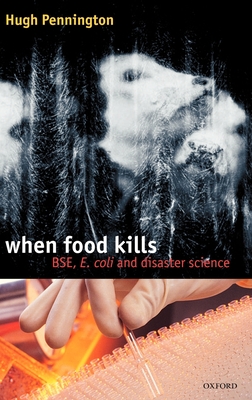
When Food Kills : BSE, E.coli and disaster science
Book Details
Format
Hardback
ISBN-10
0198525176
ISBN-13
9780198525172
Publisher
Oxford University Press
Imprint
Oxford University Press
Country of Manufacture
GB
Country of Publication
GB
Publication Date
Sep 18th, 2003
Print length
240 Pages
Weight
522 grams
Dimensions
16.60 x 24.20 x 1.90 cms
KSh 18,800.00
Temporarily out of stock, due soon
0 in stock
Delivery Location
Delivery fee: Select location
Secure
Quality
Fast
The 'food scare' concept took on new meaning in 1996, which opened with variant CJD emerging as the human form of BSE, and closed with Britain's worst E.coli O157 outbreak in central Scotland. As people died, so did trust in government and science. This book tells the story of these events, what led up to them, and what has happened since.
The ''food scare'' concept took on new meaning in 1996, which opened with variant CJD emerging as the human form of BSE, and closed with Britain''s worst E.coli O157 outbreak in central Scotland. As people died, so did trust in government and science. This book tells the story of these events, what led up to them, and what has happened since. It breaks new ground by dissecting these tragedies alongside catastrophes like Aberfan, Piper Alpha, Chernobyl, and the worst ever railway accidents in Ireland and Britain (Armagh and Quintinshill), as well as classical outbreaks of botulism, typhoid, E.coli O157 and Salmonella food poisoning. Britain''s ability to win Nobel prizes marches with a propensity to have disasters. The book explains why, demonstrating failures in policy making, failures in the application of science, and failing inspectorates. A unique feature of this book is its breadth since it covers history, politics and law as well as science. It also makes some fascinating connections, like those between 1930''s nuclear physics, E.coli, and molecular biology, and the links between manslaughter in 19th century mental hospitals, syphilis, the Nobel Prize, and the prospects for successfully treating variant CJD. Royal murderers, vaccine research in Auschwitz and Buchenwald, and the race to develop the atom bomb appear as well.For the general reader its non-technical but authoritative account of the science behind these tragedies, its critical appraisal of how the government responded to them, its coverage of public inquiries and its analysis of risk will be informative and stimulating. Scientists will find its approach to the prion theory and the origins of BSE challenging and controversial. Policy makers will find not only diagnoses of what went wrong in the past, but remedies ror the future.
Get When Food Kills by T. Hugh Pennington at the best price and quality guaranteed only at Werezi Africa's largest book ecommerce store. The book was published by Oxford University Press and it has 240 pages.
Customers Who Bought This Also Bought

Our Malady
KSh 2,000.00

Occupational Therapy and Women''s Health
KSh 11,400.00

Inner Level
KSh 2,350.00
Plague Year
KSh 2,000.00
Handbook of Social Justice in Loss and Grief
KSh 7,050.00
Research Methods for Public Health
KSh 8,300.00

Personal Health: a Public Health Perspective with Navigate Advantage Access
KSh 16,900.00

Children and Counselling
KSh 18,700.00

Care Detained
KSh 30,950.00

Understanding and Taking Control of Menopausal Symptoms
KSh 30,950.00

Intersectional Disability
KSh 30,950.00

The Biopolitics and Bioethics of Health Pseudoscience
KSh 30,950.00
