
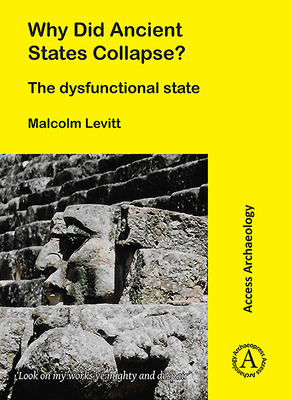
Why Did Ancient States Collapse? : The Dysfunctional State
Book Details
Format
Paperback / softback
ISBN-10
1789693020
ISBN-13
9781789693027
Publisher
Archaeopress
Imprint
Archaeopress Access Archaeology
Country of Manufacture
GB
Country of Publication
GB
Publication Date
Sep 19th, 2019
Print length
56 Pages
Weight
194 grams
Dimensions
20.30 x 27.50 x 0.90 cms
Product Classification:
Ancient WorldArchaeological theoryArchaeological theory
KSh 3,300.00
Werezi Extended Catalogue
Delivery in 12 days
1 copies in stock
Delivery Location
Delivery fee: Select location
Delivery in 12 days
Secure
Quality
Fast
Rooted in agriculture, sedentism and population growth, ancient states were fragile and prone to collapse. There is an ongoing debate about the importance, nature and even existence of state-wide collapse. This book investigates why ancient states collapsed and examines to what extent inequality contributed to their downfall.
Ancient states were rooted in agriculture, sedentism and population growth. They were fragile and prone to collapse, but there is no consensus on the causes or meaning of collapse, and there is an ongoing debate about the importance, nature and even existence of state-wide collapse.
Explanations of collapse in terms of the competing mono-causal factors are found inferior to those incorporating dynamic, interactive systems. It is proposed that collapse should be explained as failure to fulfil the ancient state’s core functions: assurance of food supplies, defence against external attack, maintenance of internal peace, imposition of its will throughout its territory, enforcement of state-wide laws, and promotion of an ideology to legitimise the political and social status quo.
To fulfil these functions certain necessary conditions must be met. The legitimacy of the political and social status quo, including the distribution of political power and wealth, needs to be accepted; the state should be able to extract sufficient resources to fulfil its functions such as defence; it must be able to enforce its decisions; the ruling elite should share a common purpose and actions; the society needs to reflect a shared spirit (asibaya ) and purpose across elites and commoners who believe it is worthy of defence.
Weaknesses and failure to meet any condition can interact to exacerbate the situation: maladministration, corruption and elite preoccupation with self-aggrandisement can induce fiscal weakness, reduced military budgets and further invasion; it can induce neglect of key infrastructures (especially water management). Inequality, a commonly neglected factor despite ancient texts, can erode asibaya and legitimacy and alienate commoners from the defence of the state.
Get Why Did Ancient States Collapse? by Malcolm Levitt at the best price and quality guaranteed only at Werezi Africa's largest book ecommerce store. The book was published by Archaeopress and it has 56 pages.
Customers Who Bought This Also Bought

Seating as Material Culture
KSh 33,850.00

Innovations in Architecture, Design, Business, Society, Language and Literature
KSh 42,300.00

Decolonizing Indigenous Histories
KSh 5,600.00

Time and Prehistoric Images
KSh 7,900.00

Keeper Of Genesis
KSh 2,000.00

Encounters: The Indian Ocean in 50 Objects
KSh 7,900.00

Bridging Times and Spaces: Papers in Ancient Near Eastern, Mediterranean and Armenian Studies
KSh 13,000.00

Archaeological Theory in Practice
KSh 27,900.00

Information and Its Role in Hunter-Gatherer Bands
KSh 4,700.00

Archaeology and the Media
KSh 7,950.00

Pedagogy and Practice in Heritage Studies
KSh 13,700.00

Bioarchaeology of the Human Head
KSh 4,800.00
More in This Genre
Seating as Material Culture
KSh 33,850.00
Innovations in Architecture, Design, Business, Society, Language and Literature
KSh 42,300.00
Decolonizing Indigenous Histories
KSh 5,600.00
Time and Prehistoric Images
KSh 7,900.00
Keeper Of Genesis
KSh 2,000.00
Encounters: The Indian Ocean in 50 Objects
KSh 7,900.00
