
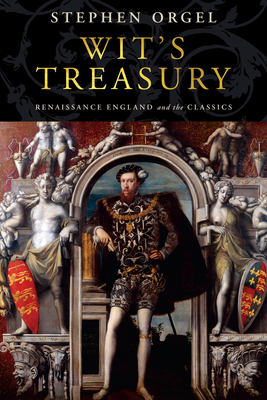
Wit''s Treasury : Renaissance England and the Classics
Book Details
Delivery Location
Delivery fee: Select location
Delivery in 12 days
As England entered the Renaissance and as humanism, with its focus on classical literature and philosophy, informed the educational system, English intellectuals engaged in a concerted effort to remake the culture, language, manners-indeed, the whole national style-through adapting the classics. But how could English literature, art, and culture, become "classical," not only in imitating the ancients, but in the sense subsequently applied to music: "classical" as opposed to popular, as formal, serious, and therefore as good?
For several decades in the sixteenth and early seventeenth centuries, Stephen Orgel writes, the return to the classics held out the promise of refinement and civility. Poetry was to be modeled on Greek and Roman examples rather than on the great English medieval works, which though admirable, lacked "correctness." More than poetry was at stake, however, and the transition would not be easy. Classical rules seemed the wave of the future, rescuing England from what was seen as the crudeness and the sheer popularity of its native traditions, but advocacy was tempered with a good deal of ambivalence: classical manners and morals were often at variance with Christian principles, and the classicism of the age would need to be deeply revisionist. "Christian humanism" was never untroubled, Orgel writes, always an unstable or even paradoxical amalgam.
In Wit''s Treasury, one of our foremost interpreters of Renaissance literature and culture charts how this ambivalence yielded the rich creative tension out of which emerged an unprecedented flowering of drama, lyric, and the arts. Orgel has here written a book that will appeal to anyone interested in English Renaissance art and literature, and particularly in the cultural ferment that produced Shakespeare, Marlowe, Spenser, Jonson, and Milton.
Get Wit''s Treasury by Stephen Orgel at the best price and quality guaranteed only at Werezi Africa's largest book ecommerce store. The book was published by University of Pennsylvania Press and it has 216 pages.
Customers Who Bought This Also Bought
How to Read a Book
KSh 2,000.00
Decolonising the Mind
KSh 4,700.00

How to Read & Why
KSh 2,350.00
Arabian Nights'' Entertainments
KSh 2,950.00
In the Wake
KSh 3,600.00
The Birth of Tragedy
KSh 1,800.00
Against Nature
KSh 1,800.00
The White Album
KSh 3,250.00
Robinson Crusoe
KSh 1,450.00
Metaphysical Poetry
KSh 2,350.00
Reading Lessons
KSh 2,350.00

Literature Book
KSh 4,250.00
More by Stephen Orgel

Texts of Shakespeare
KSh 3,600.00
Spectacular Performances
KSh 3,800.00

The Texts of Shakespeare
KSh 11,700.00

The Invention of Shakespeare, and Other Essays
KSh 3,400.00

The Authentic Shakespeare
KSh 30,950.00
The Illusion of Power
KSh 3,600.00
The Authentic Shakespeare
KSh 8,650.00

The Idea of the Book and the Creation of Literature
KSh 4,600.00
Impersonations
KSh 7,900.00

Spectacular Performances
KSh 11,700.00

The Idea of the Book and the Creation of Literature
KSh 11,000.00
The Reader in the Book
KSh 5,400.00
