
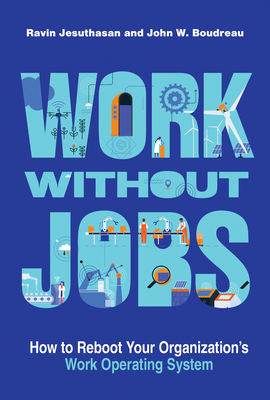
Work without Jobs : How to Reboot Your Organization’s Work Operating System
Book Details
Format
Hardback
Book Series
Management on the Cutting Edge
ISBN-10
0262046415
ISBN-13
9780262046411
Publisher
MIT Press Ltd
Imprint
MIT Press
Country of Manufacture
GB
Country of Publication
GB
Publication Date
Mar 29th, 2022
Print length
168 Pages
Weight
432 grams
Dimensions
16.30 x 23.60 x 2.70 cms
Product Classification:
Business strategy
KSh 4,850.00
Temporarily out of stock, due soon
0 in stock
Delivery Location
Delivery fee: Select location
Secure
Quality
Fast
In this Wall Street Journal bestseller, why the future of work requires the deconstruction of jobs and the reconstruction of work. Work is traditionally understood as a “job,” and workers as “jobholders.” Jobs are structured by titles, hierarchies, and qualifications. In Work without Jobs, the Wall Street Journal bestseller, Ravin Jesuthasan and John Boudreau propose a radically new way of looking at work. They describe a new “work operating system” that deconstructs jobs into their component parts and reconstructs these components into more optimal combinations that reflect the skills and abilities of individual workers. In a new normal of rapidly accelerating automation, demands for organizational agility, efforts to increase diversity, and the emergence of alternative work arrangements, the old system based on jobs and jobholders is cumbersome and ungainly. Jesuthasan and Boudreau’s new system lays out a roadmap for the future of work. Work without Jobs presents real-world cases that show how leading organizations are embracing work deconstruction and reinvention. For example, when a robot, chatbot, or artificial intelligence takes over parts of a job while a human worker continues to do other parts, what is the “job”? DHL found some answers when it deployed social robotics at its distribution centers. Meanwhile, the biotechnology company Genentech deconstructed jobs to increase flexibility, worker engagement, and retention. Other organizations achieved agility with internal talent marketplaces, worker exchanges, freelancers, crowdsourcing, and partnerships. It’s time for organizations to reboot their work operating system, and Work without Jobs offers an essential guide for doing so.
In this Wall Street Journal bestseller, why the future of work requires the deconstruction of jobs and the reconstruction of work.
Work is traditionally understood as a “job,” and workers as “jobholders.” Jobs are structured by titles, hierarchies, and qualifications. In Work without Jobs, the Wall Street Journal bestseller, Ravin Jesuthasan and John Boudreau propose a radically new way of looking at work. They describe a new “work operating system” that deconstructs jobs into their component parts and reconstructs these components into more optimal combinations that reflect the skills and abilities of individual workers. In a new normal of rapidly accelerating automation, demands for organizational agility, efforts to increase diversity, and the emergence of alternative work arrangements, the old system based on jobs and jobholders is cumbersome and ungainly. Jesuthasan and Boudreau’s new system lays out a roadmap for the future of work.
Work without Jobs presents real-world cases that show how leading organizations are embracing work deconstruction and reinvention. For example, when a robot, chatbot, or artificial intelligence takes over parts of a job while a human worker continues to do other parts, what is the “job”? DHL found some answers when it deployed social robotics at its distribution centers. Meanwhile, the biotechnology company Genentech deconstructed jobs to increase flexibility, worker engagement, and retention. Other organizations achieved agility with internal talent marketplaces, worker exchanges, freelancers, crowdsourcing, and partnerships. It’s time for organizations to reboot their work operating system, and Work without Jobs offers an essential guide for doing so.
Work is traditionally understood as a “job,” and workers as “jobholders.” Jobs are structured by titles, hierarchies, and qualifications. In Work without Jobs, the Wall Street Journal bestseller, Ravin Jesuthasan and John Boudreau propose a radically new way of looking at work. They describe a new “work operating system” that deconstructs jobs into their component parts and reconstructs these components into more optimal combinations that reflect the skills and abilities of individual workers. In a new normal of rapidly accelerating automation, demands for organizational agility, efforts to increase diversity, and the emergence of alternative work arrangements, the old system based on jobs and jobholders is cumbersome and ungainly. Jesuthasan and Boudreau’s new system lays out a roadmap for the future of work.
Work without Jobs presents real-world cases that show how leading organizations are embracing work deconstruction and reinvention. For example, when a robot, chatbot, or artificial intelligence takes over parts of a job while a human worker continues to do other parts, what is the “job”? DHL found some answers when it deployed social robotics at its distribution centers. Meanwhile, the biotechnology company Genentech deconstructed jobs to increase flexibility, worker engagement, and retention. Other organizations achieved agility with internal talent marketplaces, worker exchanges, freelancers, crowdsourcing, and partnerships. It’s time for organizations to reboot their work operating system, and Work without Jobs offers an essential guide for doing so.
Get Work without Jobs by John W. Boudreau, Ravin Jesuthasan at the best price and quality guaranteed only at Werezi Africa's largest book ecommerce store. The book was published by MIT Press Ltd and it has 168 pages.
Customers Who Bought This Also Bought
Measure What Matters
KSh 2,700.00
Harvard Business Review Manager''s Handbook
KSh 4,150.00

Never Split the Difference
KSh 2,150.00

Ego is the Enemy
KSh 2,000.00

The Upside of Uncertainty
KSh 4,500.00

The Concise 33 Strategies of War
KSh 2,000.00
Turning the Flywheel
KSh 1,800.00
Turning Goals into Results
KSh 1,250.00

Built To Last
KSh 4,700.00
Prediction Machines
KSh 3,950.00

How Big Things Get Done
KSh 2,150.00
Noise
KSh 2,000.00
More by John W. Boudreau, Ravin Jesuthasan
Reinventing Jobs
KSh 4,150.00
Lead the Work: Navigating a World Beyond Employmen Employment
KSh 4,850.00
Beyond HR
KSh 5,400.00
Short Introduction to Strategic Human Resource Management
KSh 5,300.00
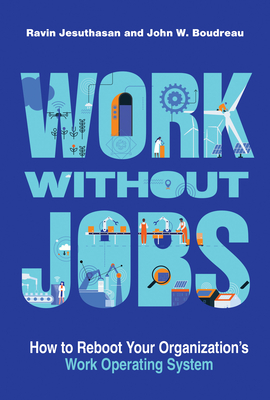
Work without Jobs
KSh 3,800.00
Short Introduction to Strategic Human Resource Management
KSh 10,600.00
Retooling HR
KSh 4,500.00

The Skills-Powered Organization
KSh 5,400.00
Achieving Excellence in Human Resources Management
KSh 9,700.00
